Wednesday, March 13, 2013

She's back!

Big shout out to fellow Brooklyn Blogger One More Folded Sunset who 
on more than one occasion, enlightened me.


Betty Rubble is back. 
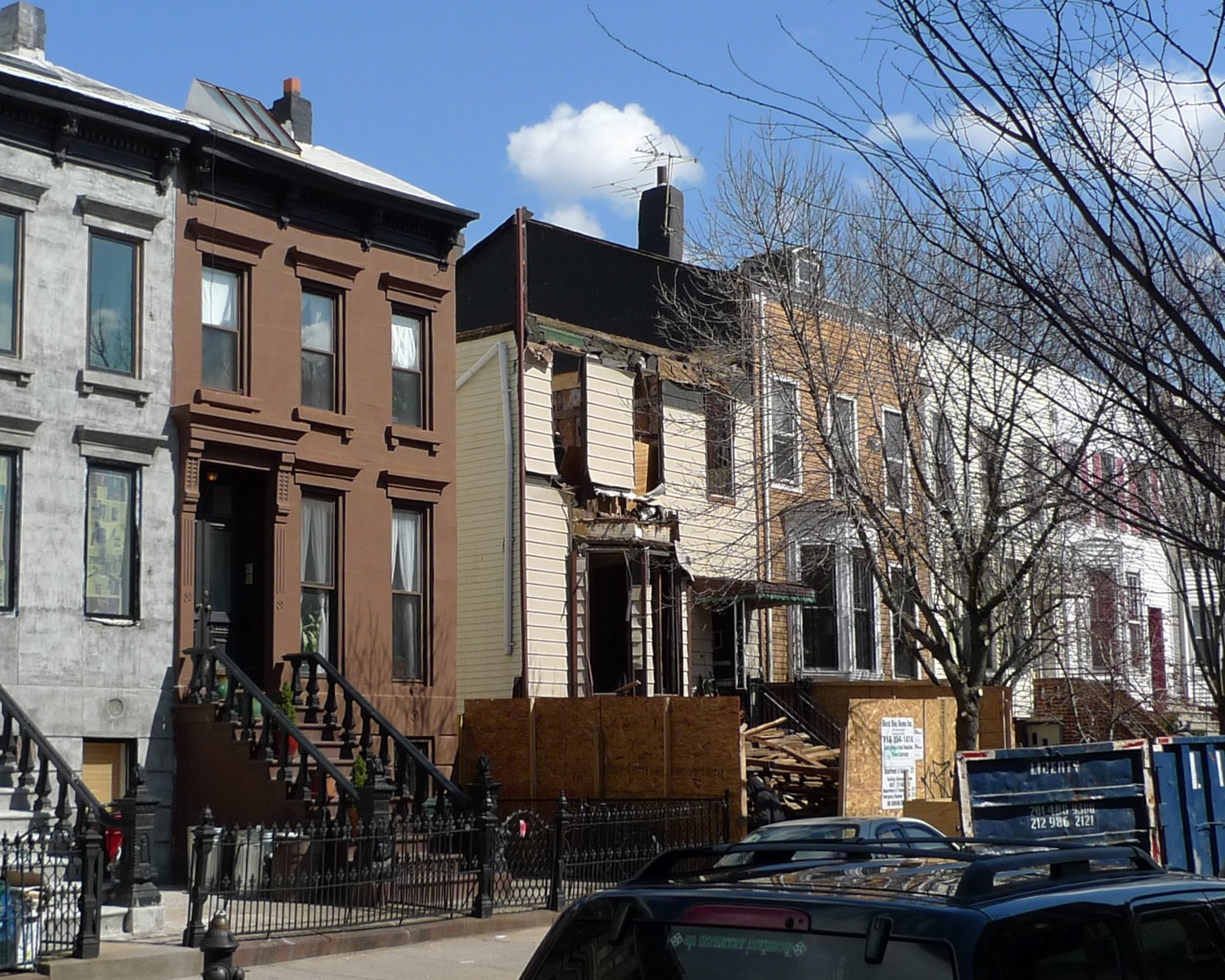
She's been called a house wrecker of ill repute, the royal mother of illegal mechanical demolition-her drag queen names might as well be Miss Blanche DeBris or Miss Eva Destruction- but most South Slopers know her simply as Marie Grasso, MMG Demolition Inc. the  ECB unpaid fine scofflaw-ess.

This time she's the documented Superintendent/Site Safety Manager for Best Buy Demo, Inc.  The 2010 start up company NYC permitted to complete the hand demolition of 315 12th Street in the South Slope.  Not sure how someone with a herstory of blatantly disregarding the well being of the public and its property can be licensed as a site safety manager.... One of the many  requirements is to "Have good moral character so as to not adversely impact upon your fitness to perform the duties and responsibilities" of a safety manager.
  

Ms. Grasso's MMG Demolition Company is famous for what DOB leadership refer to as having a "disruptive business model".   According to ECB violation records, MMG works without permits. MMG forgets to officially notify the neighbors when they are to start work. MMG doesn't post their contractor identification info out on the construction fence-Maybe because MMG doesn't know how to build a fence that will actually support the DOB paper work and remain standing for any length of time before falling over and breaking pedestrian's collarbones.
MMG doesn't provide workers with safety equipment and harnesses. MMG uses unlawful scaffolding and uncertified workers to install scaffolding. MMG works against DOB stop work orders. MMG works on weekends and after hours.
Housekeeping? The sites are often crowded and piled high with combustible debris. Sidewalk sheds? Dumpster permits? MMG doesn't use any means of dust control. MMG uses contaminated fill.  MMG will often use a back hoe with out proper mechanical demo permits. MMG fails to safeguard neighboring persons and property. MMG routinely forgets to water proof adjoining properties after exposing their side walls and foundations to the elements.
Laid Over

Site Deconstruction Supervisor Grasso actually had the honor of having a Bad Actors bill named after her-"The Grasso Bill"- introduced by Councilman James Vacca (D-Bronx).  Int. 0379-2010 is a Local Law proposed to amend the administrative code of the city of New York. It sought to bar the city from granting permits to contractors and developers who have outstanding fines, civil penalties or judgments greater than $25,000.  These ECB charges or fines can be from a variety of sources not just Buildings violations.  Currently the DOB can't with hold permits for unpaid fines, but they could if they were given the power to. 

 Unfortunately, after testimony from just about everybody from ConEd to Big Real Estate and the Construction Industry the bill was "tabled" in 2011 as being too complicated to enforce and to disruptive to the forward economic progress of our great City.  That leaves hundreds of millions of dollars of ECB debt uncollected.  Here's a proposal for ECB fines generated during new construction...Deny issuing Certificates of Occupancy to any new building with any unpaid judgements against them.   


click to engorge, Marie Grasso on the job


 Up on the roof of 315 12th Street, a worker dismantles.


IMBY Archives:  Wrecking Havoc-A partial list of unpaid fines can be found here.

Link to testimony Committee on Housing and Buildings  INT. 0379-2010

Monday, March 11, 2013

4th Avenue Concrete Giant Shadows Last Remaining Wood Frames.


548 Fourth Avenue. Architect Felix Tambasco designed this R8A zoned 9 story 93 foot tall apartment building going up quickly now on the corner of 15th Street in Gowanus.  We're looking at a sum total of 26,159 square feet divided into 15 dwelling units as well as a 691sq ft community facility space, and a required commercial/retail space of 1,697 sq ft at the street level. 


As seen from directly across Specially Enhanced Fourth Avenue standing in the parking lot of the now bankrupt for almost a year, now shuttered  Strauss Auto Center.  No plans have been filed by XYZ Property for this mega block long development site as of yet.   


548's zoning diagram


Star Spangled Banner Yet Waves
Still occupied, the well maintained 137 15th St. pictured on the left clad in patriotic red siding and its sister the already doomed to destruction 139 15th St. slam up against the new 9 story development.  ACRIS shows 139 15th, the 22 by 100 foot deep property, traded hands in 2010 for $330,000... A speculators bargain I would think considering same size lots farther up the Slope go for at least two to three times that price. 


Still standing, BEST Squad approved a mechanical demo permit of all things way back in December of 2010.  A prerequisite to extermination, rat bait stations and posted yellow warning signs.  Original? floor to ceiling double hung windows and what remains of a wooden porch and concrete stoop.  Some kind of cellar exists below the house with additional windows and door, now boarded up and filled with mud. 


A front facade covered with asphalt shingles, two brackets left exposed while the entire cornice has been hermetically sealed in a layer of tin flashing.


Second story window details. Nice bracket...


139 15th Street.  Plans have been approved for a 50' tall, four story with penthouse, 8 family apartment building to contain some 10,720 square feet of floor area. No off-street car or bike parking is required.


Schedule A for 139 15th St.


137 15th Street is highlighted in red.  
 In this 1924 aerial photograph showing the blocks just below 4th Avenue you can see the row of attached frame houses.  Fourth Avenue is considered the border between the neighborhoods of Gowanus and Park Slope South. 
For a historic look back at this corner's glory days go to this IMBY link to see the wonderfully simple Norwegian  Evangelical Free Church.  
As always Click to enlarge photos.


The same aerial shot taken in 2010 which shows the corner apartment building, 548 4th Avenue, demolished and leveled.  139 and 137 15th St. are the two remaining wood frames left from the original row of nine. Click to enlarge.

EC-1  link to zoning junk


Tuesday, February 26, 2013

Field Trip: Look 313 St. Marks Avenue! Prospect Heights.


313 St. Marks Avenue   S3 Architecture's rendering of future building.


This one's a little out of our usual South Slope stomping ground. 
A new development planned for the parking lot at 313 St Marks Avenue between Underhill and Washington in Brooklyn's Prospect Heights neighborhood.  
S3 Architecture is the firm of record.  This 50' tall four story 62,149 sq. ft. building will have 75 dwelling units with off street parking for 38 automobiles and 63 bicycles.  I have included the Schedule A for a break down of the total space.  


Why the field trip?  Actually I'm worried about the property next door.  Years ago in another life time I worked with Brooklyn based architect Brendan Coburn repurposing a little empty brick shell of a 1870's carriage house that was wedged in the rear yard of 305 St. Marks Avenue.  It was a great project.   My partner and I did the iron work.  Fine Homebuilding Magazine featured it in their 2002 Houses of the year edition. 
There is no basement. The building was built on a slab foundation.  I'm worried that this diminutive 100+ year old house will not survive intact.  New construction tends to undermine adjacent foundations.   That's been my personal experience.


A stronger voice in your neighborhood's development... 

Paranoid yes, I have had my eye on this site for a good number of years waiting for the shoe to drop.  Beware of buying homes near vacant underdeveloped property. That's my advice. You never know who or what could end up being your neighbor.  
So with that in mind let me introduce you to NYC Building's My Block, the know what thy neighbor is up to web site we visit frequently here at IMBY... An important voyeuristic tool best kept near like under our work station  in an old shoe box filled with rubber fists.  My Block lets you see what's scheduled to be demolished, altered, and maybe even as in this case, built up on your block.  It can let you know about proposed buildings and enlargements early on, even before the physical construction process has begun. 

By taking part in the Development Challenge Process you can keep developer's dreams from becoming a tad too tall, or a might bulky, or from encroaching on your rear yard private spaces.  It's your last chance to protect your light and air, but unfortunately not your sight.  There are no architectural public decency standards when it comes to artistic vision that I know of.  It may still even be of code to use adopted Russian babies as carbon monoxide detectors... I can't recall. It's not my expertise.  If you don't like the fluorescent green window box casings you can't complain to the DOB.  Basically it's beefs about arcane zoning rules that is of interest.  Peek at the zoning lot diagram if you like. It sure is a crazy quilt shaped space.


R6B zoned   1.98 FAR  60% lot coverage


Some more S3 Architecture interior renderings

Thursday, January 24, 2013

Architectural Voyeurism: 4th Avenue


                                   M I N E C R A F T

Oh Sh!t, My Sewer Main Line Done Broke...


I finally paid my overdue NYC DEP water bill last week after they threatened to turn my account over to a collection agency.  If you have not visited the DEP web site and registered an online account you really should.  They can provide homeowners with voyeuristic water usage graphs on an hourly basis. For example, I can determine just how many gallons of H20 were consumed by my
new  Toto Washlet during last night's 35 minute pleasure ride.

It was especially helpful last summer in determining just when my unsupervised hot water heater sprang a leak at IMBY's main east coast headquarters while we were away on vacation.   Insightful,  an electronic meter diligently documented over several hours my wasted water usage from what most likely, according to the DEP graphs,  began as a slow trickle  that eventually progressed to an all out gushing onslaught before my neighbor called to inform me of our mutual basement water problem and shut off the main.


So here is a recent DEP press release that I stumbled upon.  I'm sure everyone who pays a water bill will be getting some kind of sales pitch in the mail in the coming days.  I'm going to highlight some things in red.


FOR IMMEDIATE RELEASE 13-04    January 10, 2013

Department of Environmental Protection and American Water Resources Offer Homeowner Service Line Protection Programs Optional Programs Will Shield Homeowners from Unexpected Cost of Repairs to Private Water and Sewer Lines

 New York City Department of Environmental Protection (DEP) Commissioner Carter Strickland and American Water Resources (AWR) President Malcolm D. Conner today announced the launch of the water and sewer service line protection programs for residential properties throughout the five boroughs. Property owners in New York City are responsible for maintaining their water and sewer service lines, which are buried underground and run from a building to the City-owned mains under the street. On average, it costs property owners between $3,000 and $5,000 to repair a water line break and between $10,000 and $15,000 to repair a sewer line break in New York City. Homeowners may enroll in the program and pay a monthly fee to cover potential service line issues.

 “The service line protection programs are a key component of our ongoing effort to provide the best possible customer service,” said DEP Commissioner Strickland. “By informing property owners about their responsibilities and providing an optional and affordable way to protect them from unexpected repair costs, the Programs offer a valuable service to our ratepayers throughout the City.”


 “American Water Resources has been providing similar protection programs to homeowners in Long Island and other parts of New York State for more than 10 years, and we are proud to now provide a customized protection program for homeowners in New York City,” said Malcolm D. Conner, President of American Water Resources.

 To help property owners better manage these risks and the high costs of service line breaks, the New York City Water Board issued a Request for Proposals from qualified providers for service line protection programs in 2012. After a thorough review, AWR was awarded a contract to administer the service line protection programs for roughly 670,000 eligible properties in New York City.

 Water customers may participate in the service line protection programs at a present rate of $3.99 per month for water line protection and $7.99 per month for sewer line protection. For future years, the New York City Water Board will approve annual rates for the service line protection programs at the same time it adopts DEP water and sewer service charges. Customers who choose to join the programs may elect to protect both their water and sewer lines, or one or the other. They may also discontinue their involvement with the programs at any time if they no longer wish to participate. Further information about the programs and how to join will be mailed to eligible property owners beginning today, and is available online at www.AWRUSA.com/NYC or by calling 1-888-300-3570.

 The service line protection programs provide unlimited protection for covered repairs from normal wear and tear and basic restoration of affected property. They will also provide for an unlimited number of claims, 24/7 customer service, and quick response time by NYC-Licensed Master Plumbers who are pre-qualified to perform needed repairs. For the convenience of those who choose to participate, there are no claim forms to submit and no deductibles, and the protection programs fee will be itemized and included on each participating customer’s regular DEP water and sewer bill.

 At no cost to the City and an affordable cost to the customer, AWR will fully manage the protection programs – from educating homeowners about their responsibility to maintain their water and sewer service lines, to establishing a local contractor network and providing 24-hour customer service. AWR’s local contractor network is comprised of NYC-Licensed Master Plumbers, including their affiliated staff of over 200 local workers, who will be on-call to respond to the service line issues of participating customers.

 In addition to managing the service line protection programs for New York City, AWR also provides Water Line Protection, Sewer Line Protection, and In-Home Plumbing Emergency Programs to homeowners in 35 states, and AWR currently services nearly one million contracts. A subsidiary of American Water, AWR has been providing service line programs to homeowners for more than ten years and has an A+ rating with the Better Business Bureau.

 Establishment of the Service Line Protection Programs is a key component of DEP’s Strategy 2011-2014, a far-reaching strategic plan that lays out 100 distinct initiatives to help make it the safest, most efficient, cost-effective, and transparent water utility in the nation. DEP is the largest municipally owned water and wastewater utility in the United States. DEP manages New York City’s water supply, providing more than one billion gallons of high quality water each day to more than nine million residents, including eight million in New York City. The water is delivered from a watershed that extends more than 125 miles from the city, comprising 19 reservoirs and three controlled lakes. Approximately 7,000 miles of water mains, tunnels and aqueducts bring water to homes and businesses throughout the five boroughs, and 7,500 miles of sewer lines and 96 pump stations take wastewater to 14 in-city treatment plants. DEP has nearly 6,000 employees, including nearly 1,000 in the upstate watershed. For more information, visit www.nyc.gov/dep, like us on aacebook at www.facebook.com/nycwater, or follow us on Twitter at www.twitter.com/nycwater.


This is an Insurance policy.  You are essentially betting that your pipes will fail.

So I read through several PDFs provided by American Water Resources and this seems to be the poop.

First if you owe the DEP more than $500 you can't participate. LOL

The monthly fee you pay for coverage now will most certainly go up, and up.

There are multiple policies to combine or not combine coverage... Policies that will cover water lines, water lines PLUS sewer lines,  limited coverage and unlimited coverage.  LINK

AWR doesn't actually repair your plumbing pipes, they have a database of NYC approved contractors who they will hire to do the work.  You can not choose who you want to do the work.

There is also a long list, typical insurance company reasons, why they might need NOT cover you if something eventually goes wrong.  Natural disasters, sink holes, pre existing conditions ect, ect, ect.

If you are interested I recommend reading the fine print before calling to ask additional questions.

Frequently Asked Questions
Q. Why are you mailing me about my water and sewer line responsibility?
A. Most NYC Homeowners are not aware they are responsible for their water and sewer service lines. Repairs to these lines can be costly and they are not covered by most homeowners insurance policies.

 Q. What Programs are being offered?
A. Water Service Line Protection Program (WLPP) – Covers homeowners from the expense of paying for repairs due to water line leaks or breaks. Sewer Service Line Protection Program (SLPP) – Covers homeowners from the expense of paying for repairs due to sewer line clogs or breaks.

Q. Who is American Water Resources?
A. American Water Resources (AWR) was selected by the New York City Water Board as the exclusive service line protection provider of the New York City Department of Environmental Protection (DEP). AWR is the leading provider of Water and Sewer Service Line Protection Programs protecting customers in 35 states. AWR is a subsidiary of American Water, the largest investor-owned water company in the country servicing 16 million homeowners for the past 125 years.

Q. Who is responsible if these service lines should need repair work?
A. DEP is only responsible for water and sewer mains in the street. As the property owner you would be responsible for the service line repairs, and most homeowners insurance policies do not cover service line repair costs.

Q. Should I be concerned about potential problems?
A. Normal wear and usage such as aging pipes, invasive tree roots, and seasonal changes can cause your water line to leak or break, or your sewer line to clog or break. A typical water line repair costs an NYC homeowner between $3,000 and $5,000 while an average sewer line replacement costs between $10,000 and $15,000.

Q. What does the Water and Sewer Service Line Protection Program cost?
A. The introductory offer of $3.99 per month for the Water Service Line Protection Program and $7.99 per month for the Sewer Service Line Protection Program, including taxes, is good through June 30, 2013. As of July 1, 2013 the monthly cost for the Water Service Line Protection Program will increase to $4.49 per month plus tax. The Sewer Service Line Protection Program will be $7.99 per month, plus tax.

Q. What benefits do NYC homeowners receive?
A. AWR provides unlimited protection for covered water and sewer line repairs, and there is no limit on service calls. In emergency situations, a local plumber will arrive within 4 hours of your phone call. Emergency repairs are classified as those required by DEP's issuance of a 10-day notice or the issuance of Public Health Order. All other repairs are classified as non-emergencies.

Q. What is included in basic site restoration?
A. AWR will provide basic site restoration including backfilling, raking, and reseeding of the repair area. Landscaping, private walkways, and driveways are not included in basic restoration. These surfaces will be backfilled and covered with an asphalt patch. Public roadways, sidewalks, curbing, and driveway aprons are covered under the program and will be restored to city code.


Here are the actual AWR terms and conditions: LINK

SO what do you think?  If you own a home with a 50+ year old lead water line and an as least as old clay-pipe sewer main line prone to tree root clogs it may be worth your while.  I'm interested in what people think. My personal pipes are ancient.


Wednesday, January 23, 2013

New Skin: 297 15th Street Wood Frame Row House

Streetscape:  Unwrapping the bandages 297 15th Street unveils a restorative face lift.  Petrola Productions, LLC ??? purchased this wooden row house for $812,000  in May of 2011.  The renovation and conversion of this 2 family into a 1 family is brought to you by architect BENJAMIN ELLIS  of the Gowanus based firm  ELLIS +DONNELLY STUDIO  
UPDATE: Well someone just informed me that this is Dan Goldstein's new house.  This NYTimes story is a hoot.  Seems a neighbor objected to his building a legally permitted extension on the back of this house.  You can see it for your self by following this link.  The neighbor who raised the stink went ahead and sold her house for $1.4 million.  Wow, that's a great price for a wood frame.  Thing that makes me laugh is she is an administrative judge for the Environmental Control Board, one of the least effective links in our ongoing battle to control rogue contractors/speculators operating in the South Slope.  I could name two dozen neighboring properties developed in the last few years with thousands and thousands of unpaid ECB fines on the books, money still owed to the good people of Brooklyn.  

Welcome Goldstein family... Congratulations on your beautiful new home.


Early photo before completion of cornice shows new roof top bulkhead.


Bulk head not so visible now that the cornice has been completed.  Yes, plans do call for a hot tub installation


Architectural Voyeurism: 15th Street Woody


SOUTH SLOPE VICTORIAN WOOD                FISH SCALES                    PORCH BRACKETS

Friday, December 07, 2012

What passes for architecture these days in the South Slope.


548 6th Avenue.    All the charm and wit of a fire department training tower.


The roof top viewing platform offers residents the ability to get as far away as possible from the lower structure without actually leaving the property.

Front and rear balconies entitle future property owners to lord over the land as far as the eye can see while providing important bike storage facilities...  Awaiting them, a vast undulating field of aluminum-coated rooftops to dazzle the spirit.


Decorative Textured Pink Concrete Masonry Units have become part of the South Slope's now traditional architectural vocabulary.  Not unlike the symbiotic way Gustave Sennelier supplied fine pigments and oil colors to Cezanne, Gauguin and Picasso at the end of the nineteenth century, we must now fully understand the role that King's Building Materials has had in enabling the Brooklyn artist/architect to reach their own visionary heights in the first decade of this twenty-first century.


LINK 548 6th Avenue  The future looks blight.

Wednesday, December 05, 2012

400 15th Street Turns 8


can't believe we missed your eighth birthday!!!  
We were there at the birth back on September 10th, 2004... But wow, you've certainly grown up!
You have big boy windows now and a fine coat of masonry covering your backside.  
I won't forget next year, promise...The cake's in the mail as they say.

Tuesday, December 04, 2012

Solid Waste Update: NYC DOS Marine Terminal Progress


Some almost recent in-progress construction photographs of the future Hamilton Avenue Marine Waste Transfer Facility nestled between the Asphalt Plant and big box Home Depot.  Let us say, taken late September 2012.  
Brooklyn, what happens to the shit we throw out?  Check out the links below.


As seen from the upper deck of the Home Depot's parking lot.  
Drop Off:  Serpentine Drive on the right.
At the mouth of the Gowanus Canal, Future barge parking.
Rear loading area.  NYC DOT Asphalt plant off in the distance.
Rear Yard:  Containerized waste will be loaded onto barges and shipped to a small town near you.


Wednesday, November 14, 2012

Park Slope South to Lose More Wood


361 13th Street readies for demolition.


24' =The kiss of death.
Twenty four is the magic number.  That's the minimal street front width required by real property developers in order to build something profitable within the South Slope's R6B zoning rules.

Modest 361 13th Street awaits its demise, as a pre-demo;ition application has been filed.   This "1920" two story semi-detached wood frame home sold this past July for the tear down price of $795,000.   Once it's obliterated, it will allow for construction of our typical  50' tall, four family infill condo building,  the kind sprung all over Brooklyn in the last decade.

This residential 24'wide by 100' deep lot is about as big as they come in the neighborhood.  In 2006, just down the slope at 353 13th Street,  Marie Grasso's infamous MMG Contracting wrecked a similar 2 story woody to make way for a Betancorp 50' tall 4 story ( with mezzanines) condo completed in 2008.

Currently no building plans have been filed and no permits have been issued for Thirteenth St.  BAHRAM TEHRANI and BTE DESIGN SERVICES are filing this job.  Anyone know what the future holds?


As required, literate rats are given notice.   "The early bird gets the worm, but the second mouse gets the cheese."
Betancorp developed this property at 353 13th Street.        2008 sales records indicate all 4 units sold for a total of $4,253,000.


Q.  Just what is required to demolish a house in NYC?
A.  Many government agencies and lots of paper work.

For example... There is the Department of Buildings, The B.E.S.T. Squad, The Environmental Protection Agency (asbestos testing), NY Fire Department and The Department of Transportation just to name a few.  The local Coimmunity Board as well as all adjoining neighbors have to be notified.
There is also Con Ed, Brooklyn Union and Verizon as the building's utilities, all the wires, lines and pipes, have to be disconnected prior to the start of work.. And don't forget about the rats.


Sample paper work:

 Each contractor must notify the Department of Buildings' Building Enforcement Safety Team 24 hours before demolition. The premises must be enclosed, a sidewalk shed must be erected if required, and all glass must be removed.

For all buildings 15 feet tall or more, a sign stating the contractors' name, address and phone number must be posted. No demolition of a building or structure shall commence until a permit (e) Requirements for demolition permits.
(1) A complete application shall be filed Department, along with all the necessary reports and certifications.
(2) The building or structure, or affected part thereof, shall be vacant and unoccupied.
(3) All gas, electric, water, steam or other supply lines shall be disconnected and certifications by the respective utility companies or agency to that effect are to be filed pursuant to Administrative Code
§27-168. Where the use of electricity or water is required during demolition, such electric or water lines as are necessary may be maintained provided they are protected as required by the Departments of Building and Environmental Protection; provided further that the consent of the utility company is filed for the maintenance of the electric service and a certification is filed from the Bureau of Water Supply of the Department of Environment Protection that a permit for the use of water in the demolition has been issued.
(4) The building or structure shall be treated effectively for the extermination of rats and a certification shall filed to that effect by a licensed exterminator or the Health Department. (5) Where a sidewalk shed is required a permit for its erection shall be obtained and the sidewalk shed erected in accordance with Administrative Code §27-1021.
(6) Where renewal for an application for a sidewalk shed or other protective structure listed in §26-252(a) of the Administrative Code of the City of New York and pursuant to §27-1021 of the Administrative Code is required, such application must be signed by the owner of the affected property.
(7) A permit will not be issued if the applicant demolition contractor has outstanding violations of the Building Code on other demolition jobs where such applicant (i) has failed to respond to notices of violation of an administrative tribunal issued for such violations within the time required by law and has failed to cure such default and/or (ii) has failed to appear on the return date or dates or any subsequent return date or dates of any summonses issued in a criminal proceeding for such violations and has failed to remedy such non-appearance and/or (iii) has failed to comply with orders to correct such violations and/or (iv) has failed to certify such correction to the department within the time required by law and has failed to remedy such
non-compliance.
CHAPTER8 DEMOLITION
§8-01 Commencement of Demolition. (a) Definition. (1) Commencement of demolition. Commencement of demolition shall mean the removal of partitions, ceilings, flooring, windows, piping and fixtures for plumbing and heating or any component parts of a vacant building or structure to be demolished. The removal of interior wood doors shall not be considered commencement of demolition. (2) Heavy duty and light duty sidewalks sheds. A sidewalk shed is for heavy duty use or light duty use.
(i) Aheavydutysidewalkshedisdesignedtocarrya live load of at least 300 pounds per square foot (psf). Live load, including storage of materials, shall not exceed 300 psf unless the sidewalk shed is designed to carry a live load greater than 300 psf, and an application for a permit thereof is filed by a licensed architect or engineer and approved by the Department.
(ii) A light duty sidewalk shed is designed to carry a live load of at least 150 pounds per square foot. Storage of materials of any kind is not permitted on light duty sheds.
(b) No demolition of a building or structure shall commence until a complete application has been filed and a permit has been obtained from the Department of Buildings.
(c) Prior to filing of an application for a demolition permit, the applicant must submit a pre-demolition report to the Department and obtain a pre-demolition inspection and sign-off by the Department.
(d) Posting of signs. (1) Prior to the filing of an application for a demolition permit, the demolition contractor shall post a sign in a readily visible location on the front of the building to be demolished or on the sidewalk shed or other protective structure listed in §26-252(a) of the Administrative Code of the City of New York adjacent to such building with the following information:
Demolition Contractor
Name of the Contractor
Business Address
Business Telephone No.
Department of Buildings Complaint Number Date of Expiration of Sidewalk Shed Permit, if applicable
A space shall be reserved on the sign for the posting of the demolition permit
(2) Where a sidewalk shed is erected, the sign shall also state whether it is a heavy duty sidewalk shed or light duty
414
Rules and Regulations
sidewalk shed. If the shed is for light duty use, the sign shall include the statement that storage is not permitted on the shed. (3) After a demolition permit is obtained, the sign shall also contain a copy of the approved demolition permit.
(4) The sign shall be posted prior to the commencement of demolition, shall measure 25 square feet and the lettering shall be block lettering with a minimum height of three inches. The sign shall be posted upon the wall or fence or shed and shall be of contrasting color from the background. No sign shall be required when the building to be demolished does not exceed 15 feet in height. The sign must be in place 24 hours prior to commencement of any demolition activity and remain visible at the site until all work is completed.
(5) Other than as set forth above and in 1 RCNY §27-03, there shall be no other information, pictorial representations, or any business or advertising messages posted on the sidewalk shed or bridge or other structure listed in §26-252(a) of the Administrative Code which is erected at the demolition site.

A permit allows placement of a commercial refuse container at a specific location for up to five days. If a container is filled and needs to be exchanged for another container within the permit’s five-day timeframe, the carting company would not need to secure another permit. A second container added to the original location would require a separate permit.         Please note, all other requirements for placement of commercial refuse containers as per Section 2-14 (f) of the DOT Highway Rules remain in effect including:
Commercial refuse containers are containers placed on the public roadways temporarily, the use of which is not related or connected to any use or activity for which a Department of Buildings permit and/or a construction activity permit from the Department of Transportation.
Commercial refuse containers shall not be used for the storage of putrescible waste. Commercial refuse containers shall not be stored or placed within:
(i) any "No Stopping," "No Standing", "No Parking Anytime", or "Authorized Parking" areas;
(ii) fifteen feet of hydrants;
(iii) the area created by extending the building line to the curb (the "corner") or the area from ten feet from either side of the corner (the "corner quadrant");
(iv) a crosswalk or pedestrian ramp, nor shall it be stored or placed in any manner so as to obstruct any crosswalk or pedestrian ramp;
(v) five feet of railroad tracks.
The name, address and telephone number of the owner of the container shall be permanently affixed in characters at least three inches high both on the side of the container that faces the sidewalk area and also on the opposite side that faces the street, with such display being in a color contrasting with that of the container and placed approximately midway vertically.
Each container shall be stored parallel to the curb and extend no more than nine feet from the curb into the roadway.
The street shall be protected with proper covering (e.g., planking, skids, plating, or pneumatic tires) to prevent damage before containers are placed on the street. Protection shall be placed directly under each steel wheel or roller of the container to adequately distribute the weight. Placement of all protection shall be done upon delivery by the owner of the container. All planking and skids for containers shall be a minimum of 11/2" to a maximum of 3" thick. Overall size of the protective covering shall be a minimum of 12" x 12" and the placement of the protective covering shall not exceed the outer dimensions of the container..  


Links:

EPA Pre-demolition File
DOB Pre-demolition File